Autoencoder
Autoencoder Definition
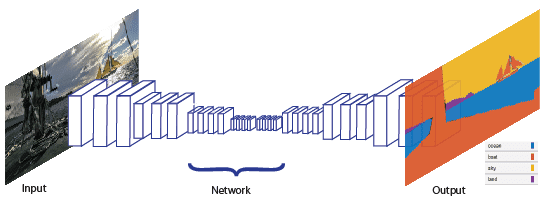
Autoencoder: Encoder (aka backbone) plus Decoder (aka head) together.
- Encoder projects input down to a lower dimension (i.e. hidden states) -> this is called compression.
- Decoder tries to replicate the original input (e.g. image or text) as close as possible -> this is called decompression.
Example: Anomaly detection:
-
Training: Train autoencoder to reconstruct image as close to real one as possible.
- Thereby the image is first broken down into lower-dimensional features (hidden states)
- ..and then reconstructed again.
-
Test (and Validate): Use autoencoder to reconstruct unseen image.
- If we get a higher error (i.e. an image is hard to reconstruct) the input image is likely quite different than the images used for training (aka out of distribution). Thus, this image might be an anomaly.
- Use error as ranking of how different the test image is compared to the images trained on (set threshold to define an anomaly)
Example: Semantic segmentation
Setup
- “Classes” is equivalent to “Labels”, i.e. each color in image segmentation is a label.
- Input image (x, y, 3) dimensions gets mapped onto (x, y, classes) dimensions where
- (x, y): width and height of image: values in range [0, 255].
- classes: number of classes (colors) in range [0, 1] (no sigmoid function run)
Input image dimensions [x, x, 3] (width, height, dimensions)
x: {0-255}Output image dimensions [x, x, #classes]
#classes: {0,1}Training
- Training: Decompose image (reduce complexity of image a lot to extract features which have a meaning, e.g. faces in a photo) and re-create image in two dimensions (two colors).
- Test and Validation: Run new image through autoencoder.
Coloring of Segementation map
- Running softmax on the output layer reduces dimensions to 1 because a “winner” color is chosen for each (x, y) pixel in image. This way we get the colored semantic segementation images.
Note: This is pixel regression (not classification). We map the range [0, 255] onto the range [0, 1].
But: Pre-trained models are still more powerful.
NB: There are more connections
See also this kaggle Notebook about image segementation.
- The Oxford-IIIT Pet Dataset offers nicely annotated data for an instance segmentation task
Feature extractor
Definitions:
- Everything which is not in output layer is a feature
- The nodes in the output layer are called classes.
Transfer learning with auto-encoders.
We call an encoder feature extractor.
Thereby we first freeze the encoder and train a classifier. Sometimes the feature extractor is
Example:
- 1 epoch train only classifier
- 3 epochs train everything
NB: fast ai has some suitable defaults here and it’s much less code.
Plus a fully-connected layer as classifier.
Definition: The head of a neural network is the classifier (located at the end).
Autoencoder without decoder: self-supervised learning.
Discuss on Twitter ● Improve this article: Edit on GitHub