Computer Vision
Computer Vision
terms
- Sampling: extra sampling
- Activition function
- Loss function
-
Transfer learning (e.g. already use parameters trained on Resnet)
- Sometimes early layers are freezed
- fastai also has a gradually increasing learning rate (as layers are closer to features)
- Global avarage pooling.
-
Reduce activiation map size by
- a) Max Polling (formerly used)
- b) Stride (schrittweite der convolution), e.g. stride size of 2 -> Don’t do convolution on every pixel, but jump and delete jumped over pixels.
- Bottleneck feature -> Last step of feature extraction before classifier (nach global average pooling)
- Random forest (forest of randomized decision trees) nach CNN. —> Other open cv data.
-
Precision and Recall
- False Positive, False Negative
-
Confused (deutsch “Verwechslung”)
- Confusion matrix lists pairs of most confusion aka wrong classifications.
- the easy split —> what is easy to separate. -> can lead to overfitting.
- matplotlib vs. plotly
Data Preprocessing Architecture
-
dataset (incl. data augmentation) + sampler —> data loader
- image augmentation: Add different variants of the image (e.g. different crops and zooms) or different colors.
- Data Augementation: Filters, like grayscale, RGB augementation, corner augmentation etc.
Architecture of a deep learning network
First layer:
How to create explanatory images to explain what a layer is responsible for
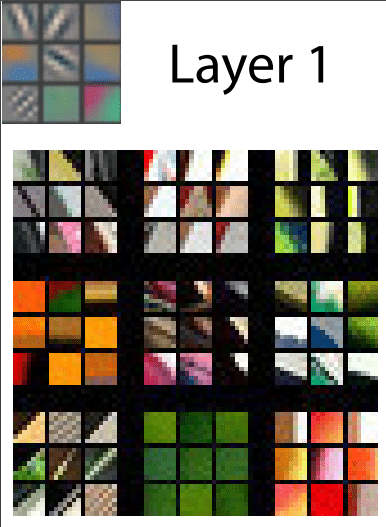
- Images taken from the fast.ai book chapter 2 (section “What Our Image Recognizer Learned”)
First layer
- Look at the neurons with highest activations.
- The neurons are directly connected to the input image.
- Look through all the images which are highly activated for a given neuron and search for similarities.
Deeper layers
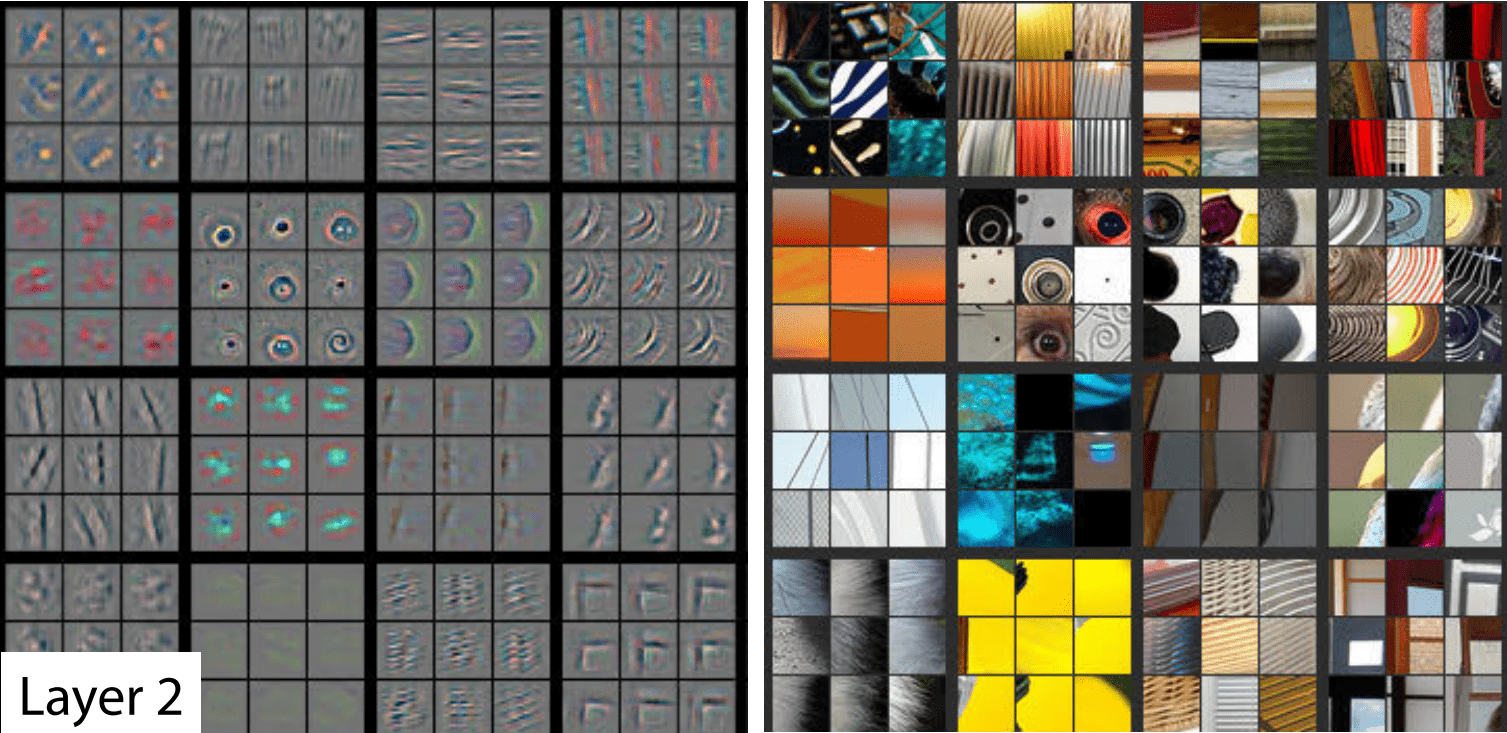
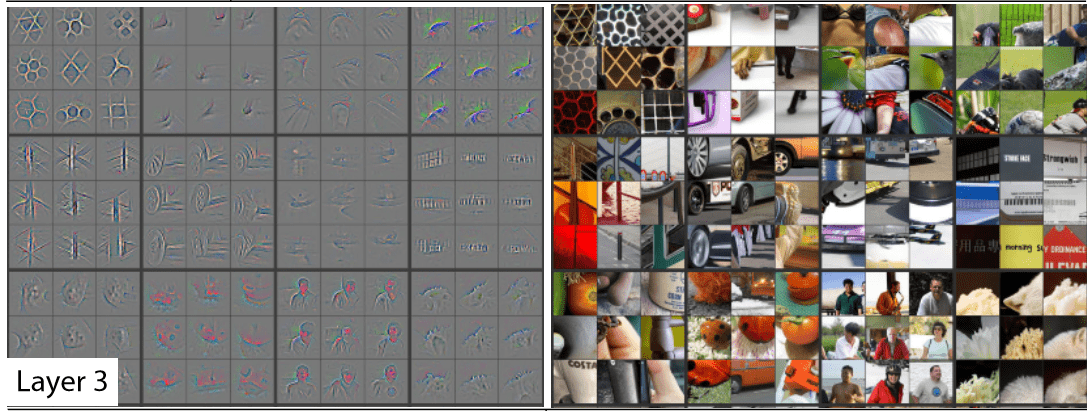
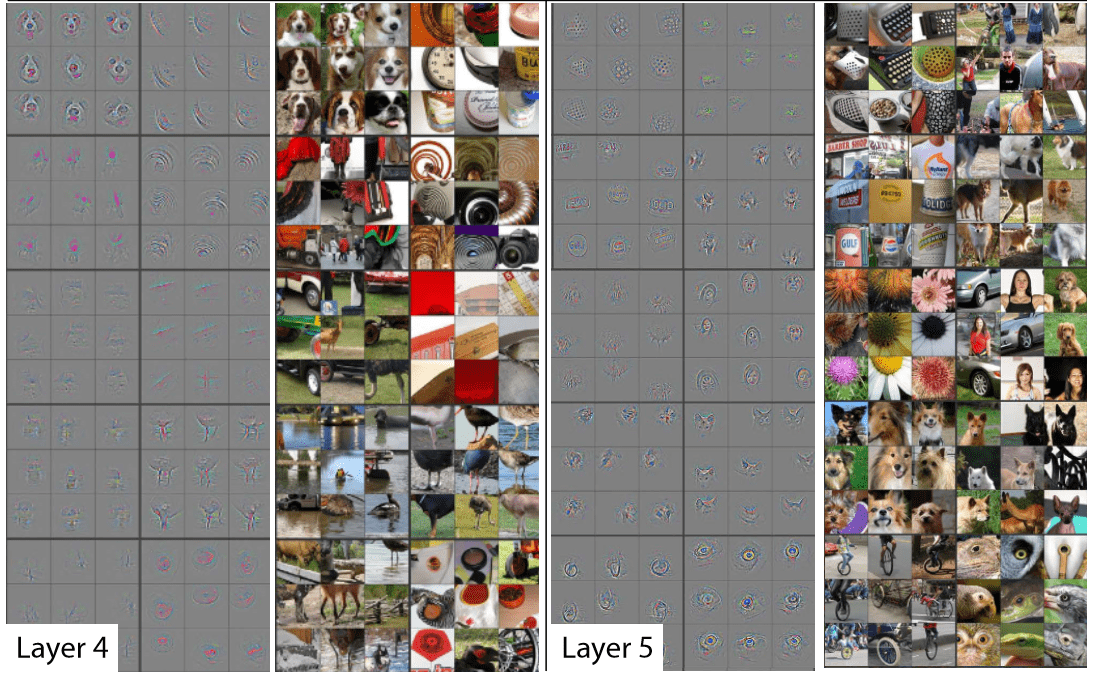
- Check for neurons with highest activations in a given deep layer.
-
Trace back these activations to the input layer (i.e. images) they’re coming from.
You’re asking the question: Which neurons in previous layers had the biggest impact on neurons with highest activity in this layer?
- For re-occuring activation patterns in a given layer (a square block of 9 activations in images on the left), try to make out semantic differences in the input image (corresponding block of 9 images on the right).
Layer 2
Layer 3
Layers 4 and 5
Annotations
- Bounding box
- Instance segementation
Error in classification of arial data
- Streets vs. Parking lots
-
Get more context!
- Field of vision (aka. influence of pixels) Sichtweite anpassen.
-
How many pixels in previous layers influenced the specific activation map (feature map)?
- This is usally a guassian curve -> pixels in the perifery influence the pixel less than pixels close to it.
- Pools vs. trampolines
-
hard-negative mining
- sample cases in which neural network has a hard job and let them be labeled.
- Get new data which is useful for you.
- relabeling —> new pseudo-classes
-
over-sampling: Create new image data by randomly copying different parts of the image to create new ones.
e.g. Filter for zebra stripes.
[ -1, -1, 1 -1, -1, 1 -1, -1, 1 ] -
ReLu activiation function is non-linear
- if linear, the whole Neural network would not be helpful, because I could just create another linear function f3 where f3 = f2(f1(x)) as a linear combination.
Images used for non-image tasks
e.g. audio processing
See fast.ai book section Image Recognizers Can Tackle Non-Image Tasks
Discuss on Twitter ● Improve this article: Edit on GitHub